
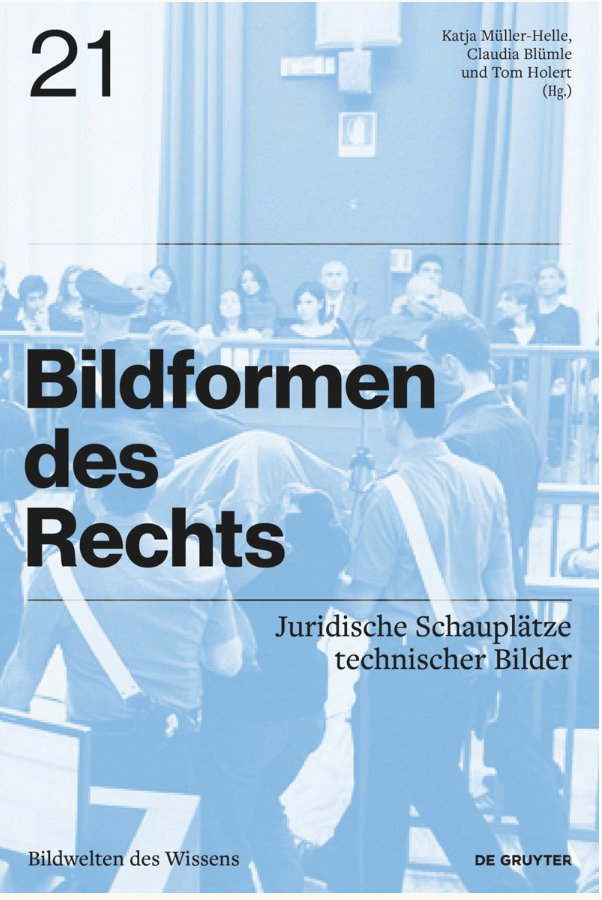
Prof Dr Ines Schaber is represented with the article "Wiedergelesen: Bernard Edelman: Le droit saisi par la photographie" in the newly published volume "Bildformen des Rechts: Juridische Schauplätze technischer Bilder". The anthology was edited by Claudia Blümle, Katja Müller-Helle and Tom Holert and is published by De Gruyter Verlag.
Based on Bernard Edelman's study on photography and law published in 1973, Prof. Ines Schaber analyses the interactions between image, law and subject as well as their significance for the present and future handling of images. At the centre of this is the question of how legal norms change under the conditions of generative AI. Image generators such as Flux, Lavida-O or Midjourney create new visual worlds and increasingly question existing concepts of authorship, copyright and image rights.
At the interface of image science, media theory and jurisprudence, the volume "Image Forms of Law" examines how technical images shape legal infrastructures and at the same time put existing legal norms under pressure. The contributions combine current debates on AI, copyright and intellectual property with the history of photographic and filmic image media.
The publication appears in the series "Image Worlds of Knowledge" and brings together interdisciplinary perspectives from image and media studies, legal theory and artistic research.
The publication is available as an e-book from De Gruyter.
Based on Bernard Edelman's study on photography and law published in 1973, Prof. Ines Schaber analyses the interactions between image, law and subject as well as their significance for the present and future handling of images. At the centre of this is the question of how legal norms change under the conditions of generative AI. Image generators such as Flux, Lavida-O or Midjourney create new visual worlds and increasingly question existing concepts of authorship, copyright and image rights.
At the interface of image science, media theory and jurisprudence, the volume "Image Forms of Law" examines how technical images shape legal infrastructures and at the same time put existing legal norms under pressure. The contributions combine current debates on AI, copyright and intellectual property with the history of photographic and filmic image media.
The publication appears in the series "Image Worlds of Knowledge" and brings together interdisciplinary perspectives from image and media studies, legal theory and artistic research.
The publication is available as an e-book from De Gruyter.