
Programme
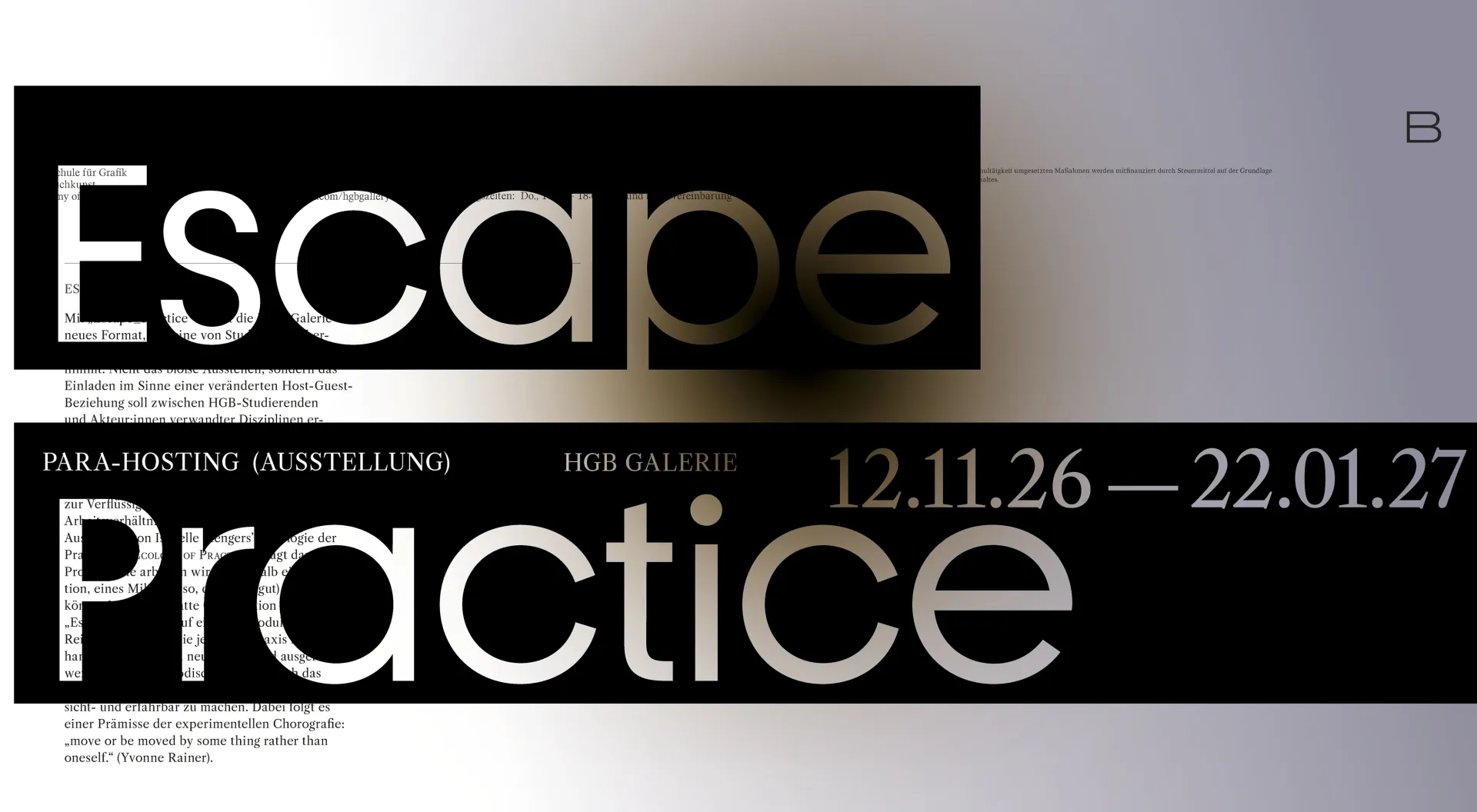
With "Escape_Practice", the HGB Gallery is launching a new format that takes a student-produced curatorial situation as its starting point. Rather than mere exhibition, the act of inviting—conceived as a transformed host–guest relationship—is to be tested, performed, and developed between students and practitioners from related disciplines. In this process, escape(Paul O’Neill) is not understood as an escapist flight, but serves as a collective tool to fluidify entrenched roles and working dynamics.
Drawing on Isabelle Stengers’ “Ecology of Practices”, the project asks: How do we work—within a situation, within a milieu—so that everyone can work (well)? Rather than relying on seamless organization, Escape_Practice centers on a field of productive friction, where individual practice can be recalibrated and realigned through negotiation with others. Methodologically, we draw on scores to make movements of escape visible and tangible within space. In doing so, the project follows a premise of experimental choreography: “move or be moved by some thing rather than oneself” (Yvonne Rainer).
The ongoing program and additional dates will be published here and on www.instagram.com/hgbgallery
All events take place at the HGB Gallery.
Program November:
Thu 12.11.2026 Mira Mann: Performance and Lecture
Thu 19.11.2026 Janneke van der Putten: Stimme und Raum (Workshop and Performance)
Tue 01.12.2026 Thomas Locher: DisPLAYing
Mon 07.12.2026 Fedele Friede: Groundwork. A Room without Walls (Lecture and Workshop)
Tue 08.12.2026 Fedele Friede: Groundwork. A Room without Walls (Workshop)
Thu 10.12.2026 Performance by Pol Pi
Thu 07.01.2027 Julia Müllner: Tiny (Performance und Talk)
Tue 12.01.2027 Fedele Friede: Groundwork. A Room without Walls (Workshop)
Wed 13.01.2027 Martin Schneider: im zuhören ein suchen finden (open listening situation)
Thu 14.01.2027 Martin Schneider: im zuhören ein suchen finden (open workspace)
Wed 20.01.2027 Lena Meral Albrecht: theatre performance
“Escape_Practice” does not present anything finalized. What began in the seminar “Further Notes on Lightness” is brought towards a situation of methodological unrest by HGB students and their guests. Here, lightness is tested as a form of resistant movement that unfolds within the process of a shared practice. The curatorial manoeuvre of “Escape” (Paul O’Neill) therewith turns the concept of “becoming light” into something concrete: not an escape from the impositions of the contemporary, but rather the slow undermining of those routines and hierarchies that reproduce those conditions within the exhibition context.
For O’Neill, “Escape” takes place within the realm of hospitality: those who want to escape societal constraints need to renegotiate the relationship between “host” and “guest.” As so-called “Para-Hosts,” the participants turn the act of inviting itself into a method—tested, performed, and developed together with the “Para-Guests”, to loosen the rules of artistic doing with external impetus. In this way, escape seeks new alliances across established affiliations and working relationships. Drawing on Isabelle Stengers’ “Ecology of Practices,” the aim is to create an environment that does not smoothen or resolves emerging divergences, but instead understands them as a necessary condition: how do we work in such an environment so that everyone can work well, without one practice merely becoming a resource for another?
“Escape_Practice” takes its starting point directly from the physical floor. The change in colour from RAL 7046 (telegrey)—a signature colour of technical and administrative standardization—to RAL 7044 (silk grey) marks the beginning of a gradual spatial transformation. Rather than placing artworks, the architecture itself is redefined as the project progresses: changeable lighting setups, painterly gestures, mirrors, and displays intervene in the space, while a waist-high threshold disrupts the usual movement of bodies. The gallery reconfigures from a showing machine to a shared infrastructure that provides time and space for situational, multivocal “Escape” actions.
This takes shape along scores—loosely guided by Yvonne Rainer’s choreographic premise: “move or be moved by something rather than oneself.” In the space, this scoring manifests as a mobile field of notation in the form of an unfolding paper roll, along which practices such as “Queering the Voice” are exercised. Performative, sonic, and discursive contributions from the guests, or the “para-hosting” of displays and artistic works, challenge the established situation and directly intervene in its rhythms. As a mode of “photographic witnessing,” a camera accompanies the action in a scenic and playful manner—not as detached documentation, but within the resonant field between the bodies. Three pairs of binoculars invite the audience to establish their own lines of sight, while a sound piece on “Black Holes and the Expansion of the Universe” acoustically breaks down the institutional walls. Between conception and spatial execution lies an affective dimension that understands “becoming light” as a protest against the depressing paralysis of the present. In touching these rigid moments, a collectively produced “Escape” disrupts such institutionalized emotional states. At the same time, a collective need to reorient oneself might emerge: infrastructural, phantasmal, solidary.
“Escape_Practice” thus opens up a testing ground in which the rules of collaborative work are put to the test while using the space, and are continually reinterpreted and questioned by the movements within it. It starts on November 12 with artist Mira Mann, whose reading and performance will activate the evolving spatial situation both sonically and physically.