


Hilfe

Impressum

Rundbrief

Suche

Übersicht

Kontakt

Secure Socket Layer

JavaScript

English


Design und Programmierung
  • Joachim Blank
  • Uwe Klaus
  • Mario Röhrle
  • Jan Sledz
  • Tamas Szakal
  • Severin Wucher


Copyright (C)
2001-2003

8349030
   

Art and Media in the XX. century

1. Beyond Objects

It is intolerable that drawing and painting still stand exactly where writing stood before Gutenberg.
André Breton, 1934 [1]

The history of the avant-gardes, in the century that is now drawing to a close, has as a leitmotif the constant redefinition of the ’work‘ of visual art. The assumption that an artwork is a handmade object is as old as art history. In a world that consists entirely of handmade objects, such as a mediaeval living-room or an African clay hut, this confers no particular status. Only since the extension of industrial manufacture to almost all the objects of daily use – and, above all, since the proliferation of techniques for reproducing objects, images, sounds and texts – has the handmade object acquired the cachet of something original or unique. In European art history, the primary distinction between original and copy equates with that between idea and execution – as with an etching after an oil painting, or a plaster cast after a marble statue. In the course of the twentieth century, the meaning of the term ’original‘ has changed, so that in art it now primarily denotes objects made by human hands, as distinct from images generated by technology. In marketing, by contrast, the words ’The Original‘ can be extended to apply to a branded article.
The twentieth century will go down in history as the period in which manual, individual production was almost entirely supplanted by mechanical, industrial manufacture. This applies both to everyday objects, such as clothing, furniture and tools, and to the means whereby signs and images are transmitted, generically known as the ’media‘. It also affects the status of the work of art – a point probably first and most clearly made in Marcel Duchamp‘s principle of the Readymade.
In an environment largely made up of industrial products, any object declared to be original acquires a privileged status that affects its aesthetic as well as commercial valuation. Writing in the 1930s, Walter Benjamin looked forward to the day when photography and film would emancipate the work of art from its ’parasitic relationship to ritual‘, as defined by its ’aura‘ of uniqueness, of being an original. He wanted to see the question ’whether photography is an art‘ replaced by the far more fundamental question ’whether or not the character of art as a whole has been changed by the invention of photography‘. [2]
Anyone who now walks through one of the great international art fairs will see photographs on every side, immaculately framed, in the same large formats and at the same price levels as paintings. The establishing of ’degrees of authenticity‘ for the technical reproductive media – a task that Benjamin regarded as impossible – has long been part of ’business as usual‘ in the art trade. This process is even more conspicuous when the concept of the original is applied retrospectively – as witness the meteoric rise in prices of vintage photographs over the past twenty years. It is just as irrational to congratulate photographic artists, 175 years after the invention of photography, on attaining parity of status with painting, as it is, conversely, to deplore their failure to break free of the notion of the ’original‘ as a criterion of value. The fact is that the mechanisms of value-creation based on the status of the ’original‘ fit in perfectly with the marketing of mass-produced reproductions. The eminence of the original generates a need for ever more reproductions, which in turn lead to even greater fame and still further enhance the value of the original. This same principle of the ’idolisation‘ of the original can be seen in operation in other areas besides fine art, including fashion, design and advertising.
Despite this transformation of the term ’original‘, it is clear as we look back over the twentieth century that the object status (and attendant commercial value) of the work of art has been a major abstacle to the evolution of the arts in a more comprehensive, more interdisciplinary direction. ’Media‘ art forms – those other than painting and sculpture – have been undervalued, and evolutionary lines have come to an untimely end for want of distribution and recognition – or simply for want of money. Within the distribution system of the fine arts, film and video, for instance, are not only harder to exploit commercially but more expensive to produce than painting. To the day painting remains the medium best suited to the current system of diffusion for the visual arts.
Perhaps no area of human culture has changed so radically over the last 150 years as the production of images. Pictorially, until the middle of the nineteenth century, the domain of ’art‘ and that of ’the media‘ were identical. But then the great divide between manual methods and technology created the distinction between art, which remained in the singular, and ’the media‘, endlessly proliferating in the plural.
Between pictorial art and pictorial media there is one fundamental distinction: that between exclusivity on one side and mass dissemination on the other. In essence, this distinction is neither ideological nor technological, but economic. It separates two markets and two distribution systems governed by contrary laws. Is art therefore the last context in which the Marxist critique of the conditions of production (otherwise only of historical interest in the so-called postindustrial society) still holds good? It may well seem an anachronism that, in this age of mass media, visual art should still base itself on the sale of (in a wider or narrower sense) original objects. But then art does not always reflect the current state of theoretical knowledge. Even Benjamin‘s utopian vision of a new function for art never came to pass because – percipient though it was – it still referred to the reproduction of images and things: the word media does not appear in Benjamin. The art/media antithesis can be overcome only by treating the work of art as information, to be transposed into a variety of media. It was clearly Bill Gates, founder of Microsoft, who first took this to its logical conclusion: instead of artworks he collects the reproduction rights of artworks, with the aim of distributing them as image data via the Internet.

2. Between the Genres

No work of art of any consequence has ever fitted perfectly into its genre.
Theodor W. Adorno, 1969 [3] created

Given the problems faced by those who work in the field of visual art but create no ’original‘ objects, what reasons can an artist have for using technological media?
By the nineteenth century it was already clear that art had ceased to stand at the cutting edge of human cultural achievement. The leitmotifs of social evolution are technology and science; their criterion is rapid progress. In his book on Cubism, published in 1913, Guillaume Apollinaire sums this up when he writes that people now parade through the streets in triumph carrying aloft the aeroplane in which Louis Blériot first flew the Channel, just as once they carried the paintings of Cimabue. Apollinaire looks forward to the day when a new generation of artists – artists who, ’free of aesthetic scruples, think only of energy‘ – will succeed in ’reconciling art and the people‘. [4]
However, the marginalisation of art was not simply a matter of technological progress: it was also a response to the increasing radicalism of the avant-garde. It was at the beginning of the twentieth century that art first avowedly parted company with ’common sense‘. In Europe, the years 1905-15 saw the emergence of an unprecedented profusion of new ’isms‘: Fauvism, Expressionism, Cubism, Futurism, Suprematism, Dadaism, to mention only the best-known. In itself this rapid pace of change, which intensified the social isolation of the avant-garde, was art‘s response to the principle of uninterrupted progress, as established by technology and science: [5]
Comrades! We tell you now that the triumphant progress of science makes profound changes in humanity inevitable, changes which are hacking an abyss between those docile slaves of past tradition and us free moderns, who are confident in the radiant splendour of our future.
We are sickened by the foul laziness of artists who ever since the sixteenth century have endlessly exploited the glories of the ancient Romans. [6]
This clarion call, from the ’Manifesto of Futurist Painters‘, issued in 1910, pinpoints the sense of inferiority that afflicts artists in their relations with technology and science – and still to this day sets the tone of the art/media debate. This lack of confidence in the efficacy of art went deep, as the Futurist manifesto shows; it was also widely shared – as transpired in the same year, 1910, when a new style, complete with manifesto, was launched at the Salon des Indépendants in Paris under the name of ’Excessivism‘. It provoked violent reactions in the press – until it emerged that the one and only painting in the new style had been produced by a donkey, using its tail as a brush, in a scenario devised by a caricaturist, purely to create a scandal. As the exploitation of this scandal revealed, the volume of information has grown to such an extent that public attention can no longer be secured by the work of art on its own, but only by widespread diffusion through the media (above all, the daily press, in the case of the donkey‘s tail, cited above).
This brings us to a central problem of modernism. As forms of expression became increasingly radicalised, public acceptance diminished; in the end, the ’man in the street‘ came to associate the words ’modern art‘ with total balderdash. This directly frustrated the artists‘ growing need to step outside the bounds of visual art and of its institutions, which during the nineteenth century had become increasingly circumscribed, and to regain some degree of influence within society. Clearly, the desire that art should keep pace with the march of technology could not be fulfilled, simply by applying the principle of technical perfectability to artistic forms of expression. This dilemma of modernism ultimately springs from the fundamentally different ways in which historical evolution operates in art and in technology.
On one hand, the rapid technological progress of society as a whole primarily reflects a constant process of innovation in the means of production, information and distribution; any attempt by art to respond to this through innovation in its forms is doomed to fail unless accompanied by an equally radical change in its artistic techniques and channels of distribution: that is, its media. On the other hand, the problem cannot be solved merely by putting to artistic ends the new media that have evolved as industrial technologies. Artistic innovations such as Cubism and abstraction cannot simply be transposed onto the mass media in order to reach a wider public. They refer specifically to just one ’medium‘, that of painting, which – to counter the dominant role of photography in the depiction of reality – they reduce to its basic and original qualities.
The new image technologies have their genesis outside the arts; but, in seeking a cultural place for themselves, they initially gravitate to the artistic genres as traditionally understood. Only through the interaction with and between these genres can new media acquire something of a cultural history of their own – as can be seen in the emancipation of photography from painting, which was partial and diffident at first; or in the later, and markedly quicker, emancipation of film from theatre. By contrast, in the second half of the twentieth century such techniques as video and computer animation have evolved no cultural identity of their own at all. Both video art and computer art – marginal though they have remained, both to the industrial development of the techniques involved and to the arts as a whole – are indispensable as symbolic relics of the intellectual history of technology and as a mirror of changing cultural attitudes to these now dominant image media. From photography to virtual reality, all the so-called new media hold a cultural position in between or outside the existing artistic genres. Anyone who wants to work in them has to begin by reassessing and recombining elements of existing genres in order to make himself/herself understood. No artist – visual, musical or literary – can switch from one medium to another without simultaneously raising the question of the boundaries of the genre. The art/media relationship is thus conditioned by the principle of ’intermedia‘ – the overlapping, or (as Adorno called it) ’fraying‘, [7] of genres – but without the nineteenth–century ambition of creating a Gesamtkunstwerk or holistic synthesis of the arts.
In its relation to art, the intermedia principle operates in two ways. Internally, in the evolution of art as such and in relationships among the individual arts, genre crossover becomes the central principle of innovation and finds its application in new media techniques. Externally, in the relations between art and society, it overrides the contexts, conventions and institutions associated with individual genres and thus allows a constant redefinition of the role of art. When these two processes coincide, new genres may be created, as in the cases of photography and film, but only as transitional stages in a constant, progressive dissolution of genre boundaries. Video art is a case in point: its present status is somewhere between artistic genre and technological medium, and it is on the point of being overtaken by a wave of new, digital image techniques. When artists work with new media techniques, what is happening is not the creation of new genres but a fundamental reappraisal of all existing genres, and ultimately of the limitations of the notion of ’genre‘ as such.
All this may give the impression that technological progress is the sole motive force of artistic innovation. Not at all: the history of art reveals that, in almost every case, the autonomous dynamic of artistic evolution reaches and passes the limits of the given genre before a new technique appears and is thankfully adopted. Often, artists‘ projects far outstrip the current limits of technological or media feasibility; they bear early testimony to an awareness within society as a whole, which only then seeks out the technology required for its realisation. This profound parallelism between artistic and technological innovation has yet to be analysed. By contrast, nothing is more vacuous and feeble than those forms of ’media art‘ which spring from no inherent artistic dynamic but aim to innovate solely through technological progress; the results are no more than an illustrative apologia for technology.
The rivalry between the arts – the comparison or paragone that has been a vital impulse in artistic evolution ever since the Renaissance – is giving way to an interaction between the genres. The essential impulses, and problems, of the relationship between art and media are those of crossover, not of competition. As a stimulus to innovation in the arts, this crossover is a fundamental principle of modernism; as an often unavailing attempt to break through bounds conditioned by social forces, it points to the utopian function of art.

3. Case by Case

No theory can stand up without examples – least of all when it takes leave of the guiding thread of genre-related discourses. The innovative force of interaction between genres can be illustrated only by concrete, individual cases: for example, by the following specimen materials for a history of cross-media developments in twentieth-century art.

Artists on Stage

The simplest and most direct way to reach an audience is to perform on a stage, if possible in front of a full house. This elementary realisation is the starting-point of numerous attempts by the twentieth-century avant-garde to gain a hearing for its ideas outside conventional channels. The Futurists in their serate, and the Dadaists in their soirées, took the stage to declaim manifestos, recite poems, show paintings and present new forms of music and dance, sometimes with extraordinary costumes and masks (Figs. 1 and 2). Phonetic poetry and simultaneous readings of different texts, accompanied by actions, were new, performance-related forms of literature, which found reflection in experimental typography and montages of words and pictures. Benjamin was the first to see that this ’simultaneity‘ was the anticipation of cinematic effects by, as yet, inadequate means. [8]

Nothing but Optics

From the 1920s onwards, rumour had it that Marcel Duchamp had given up art in order to devote himself to other concerns. Among these were chess and the making of optical devices such as the Rotative plaques verre (optique de précision) of 1920 (Fig. 3). When viewed along the axis of the rotor, the rotating glass plates create an optical effect: according to speed, the spiral painted on the near side seems to contract or to curve outward. Other experiments of the same kind led to the film Anémic Cinéma (1925-26) and to the Rotoreliefs (1935), which went into large-scale production as optical toys. Duchamp repeatedly insisted that these pieces were just ’optics‘ and not ’art‘. [9] They form part of the repertoire of the profoundly ironic para-science that had led Duchamp, back in 1913, to install a freely revolving bicycle wheel on a stool, like a test-bench in a pseudo-physics lab (see Fig. 9, p. |).

Painted Music

A dramatic – and at times a tragic – chapter in the evolution of intermedia art is the (still inadequately studied) genesis of the abstract film. This came about as part of the great modernist utopia of ’synaesthetics‘: the amalgam of music and painting. There were numerous nineteenth-century attempts to make instruments that would render music visible; and in the early twentieth century the pioneers of abstract painting – including individuals as dissimilar as Wassily Kandinsky and Francis Picabia – seized upon music as the prototype for a visual art that would achieve a direct aesthetic and emotional effect without representing reality. All the pioneers of the abstract film started off as painters before trying to add the dimension of motion to their painting in the search for a marriage of visual art and music. [10]subsequently
Walther Ruttmann, the long-forgotten maker of the first abstract film (Fig. 4), wrote in 1919 that technological progress would accelerate the transfer of information, leading to a ’constant state of being swamped with material‘ – and thereby to an altered state of perception. As a result of this, a ’new, hitherto latent type of artist would emerge, approximately half-way between painting and music‘. This ’new art . . . can in any case expect to reach a considerably wider public than painting now has‘. [11] Similarly, Viking Eggeling referred to his drawings of 1920-21, which he converted into films (Fig. 5), as ’formative evolutions and revolutions in the sphere of the purely artistic (abstract forms), roughly analogous to the events which take place in music, and with which our ears are familiar‘. [12] This vision of painted music demanded more energy from the artists concerned than almost any other form of art. They worked with manic determination to convert their ideas into reality; and to this cause both Ruttmann and Eggeling sacrificed all their money and, to some extent, their health. The technical and financial difficulties involved in making the early abstract films are exceeded only by the historical calamities that subsequently befell them. Every one of those films is now either completely lost or preserved only in a fragmentary state. [13]
That the combination of music and moving pictures could indeed achieve the popularity dreamed of by the pioneers became apparent only with the success of popular music videos from the early 1980s onwards. This could happen only because in rock music, for the first time, the former ’subculture‘ became big business and gained access to the mass media.

The Picture Made of Light

The direct reproduction of objects placed on a light-sensitive surface was practised in the very early days of photography by Henry Fox Talbot, who in the 1840s sought to use his discovery, the ’pencil of nature‘, to compensate for his own lack of talent as a draughtsman. But the use of the camera relegated the technique to oblivion, until it was rediscovered in 1918 by Christian Schad and again in 1921 by Man Ray; in almost identical terms, both artists tell us that this happened entirely by chance, through a darkroom accident. Schad, who worked within the ambit of Zürich Dada, treated his little ’Schadographs‘ as abstract compositions of materials. He soon abandoned these experiments and – in a radical change of style – went on to become one of the most brilliant portrait painters of Neue Sachlichkeit.
Man Ray discovered the ’Rayograph‘ (Fig. 6) in the context of Parisian Surrealism, and employed it as the technique appropriate to ’automatic‘ creation – as is evident from the title of his portfolio, Les Champs délicieux (Delicious Fields, 1922), with its reference to André Breton‘s and Philippe Soupault‘s first joint effort at ’automatic writing‘, Les Champs magnétiques. According to Tristan Tzara, Man Ray‘s portfolio set, photography on an equal footing with painting for the first time. The photographic process serves to record a state of mind‘. [14] The Surrealists regarded automatic writing not as a representation ’of something‘ but – like a cardiogram or an encephalogram – as a direct trace of psychic processes. Clearly, therefore, the ’automatic‘ image provided by photography is a suitable medium for the transference of this literary technique into the visual arts. But it is only by dispensing with the ’objective‘ camera – a step backward in technological terms –that photography can match poetry or painting in lending direct expression to a ’subject‘. Only a media paradox could fulfil Man Ray‘s lifelong ambition to be recognised not only as a photographer but also as a painter.
At the Bauhaus, László Moholy-Nagy used the same technique under the name of the ’photogram‘. His aim here, as in photomontage (which he called Fotoplastik or photo-sculpture), was to create on a plane a constructive representation of things in space. He had no interest in intuitive, ’automatic‘ depiction: on the contrary, the controlled, deliberate use of the new technique would enable the artist, to handle light with sovereign assurance as a new means of formal creation, like colour in painting or sound in music‘. [15] Moholy-Nagy was explicit about his interest in overcoming the boundaries between genres:
The unavoidable phase of fumbling with traditional, optical forms of depiction is now behind us and need no longer stand in the way of the new work. We now know that working with captive light is a different thing from working with pigment. The traditional picture is a thing of the past. Opened eyes and ears are filled at every instant with a profusion of optical and phonetic wonders. [16]
This programme led Moholy-Nagy to project the chiaroscuro effects of the photogram into real space by means of his Light-Space Modulator (or rather Light Property for an Electric Stage) of 1922-30 (Fig. 7). He went on to make a film of the result. Man Ray‘s unpremeditated psychic automatism had given way to a precisely programmed electromechanical automaton.
The elementary principle of direct photographic exposure thus serves to link two entirely different, not to say antithetical, artistic intentions. Every time the technique appears, it does so at a crossover point between genres: in Schad‘s case, between collage and photography; in Man Ray‘s, between literature and painting; and in Moholy-Nagy‘s, between the photograph, the film, the light-generating object and the theatrical stage.

Directed Chance

In his musical compositions, from 1951 onwards, John Cage assigned a central role to indeterminacy governed by chance. This was also the time when he began to make use of audio tape. The resulting pieces can no longer be written down in musical notation but demand a graphic structure. The score for Cage‘s best-known tape composition, Fontana Mix of 1958, consists of twenty-two drawings, twelve of them on transparent film (Fig. 8). By recombining the pages of the score with each other and with a variety of overlays, the work can be interpreted in many ways quite different from the one adopted by Cage on the tape recording; and many of these ways transcend the bounds of musical form. In 1958, in conjunction with the score of Aria, that of Fontana Mix served as the basis of a purely vocal piece based on sounds from five different languages. In 1959 it was used for Sounds of Venice and Water Walk, two pieces made for television; in 1960 Cage used it again for his Theatre Piece, to be performed by between one and eight musicians, dancers or actors, who must carry out between fifty and a hundred actions each. The same score can thus serve for a tape montage, an a cappella vocal piece, a TV broadcast, or a theatrical performance. [17]
In the 1960s the notion of the ’open work‘, coined by Umberto Eco on the basis of the New Music, became the basis of a new, trans-genre aesthetic for which Cage was a central source of inspiration. The new role played by the audience in Eco‘s ’open work‘ foreshadowed the different principle of interactivity, which emerged along with the digital media in the 1990s.

Television as a Creative Medium

Fluxus might be described as the last movement in twentieth-century art. Without ever forming a style, Fluxus gave those involved a strong sense of collective identity, based above all on two fundamental aspects: internationalism and intermedia. [18] As distant aspirations, both have haunted many modern movements, from Futurism to Surrealism; but only Fluxus turned them into a way of life that made possible a genre-breaking form of art with a nonhierarchical, decentralised structure.
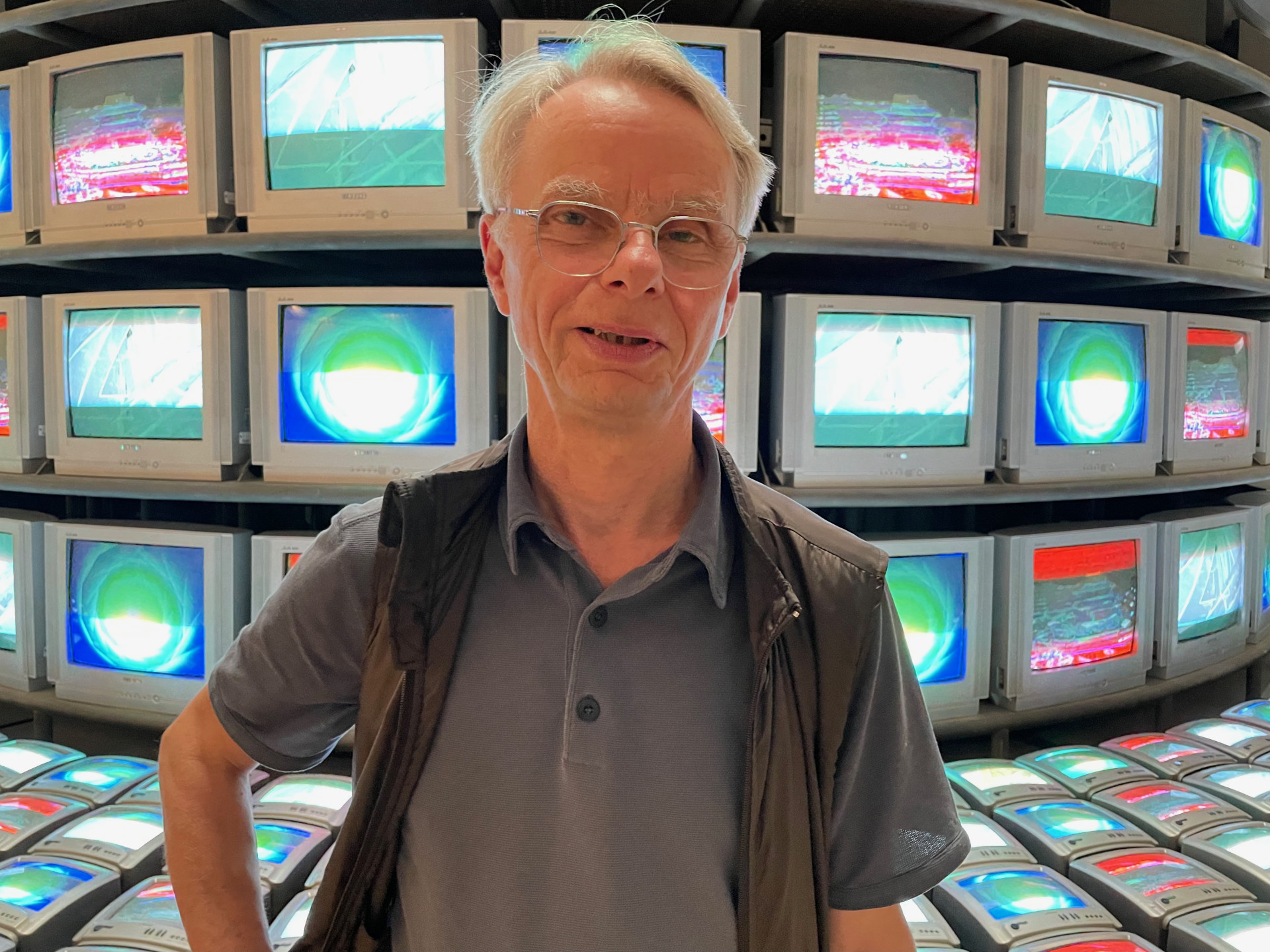
Nam June Paik is the typical – indeed the ideal – embodiment of this. As a Korean musician in Germany, he proceeded by way of the New Music to the electronic image; then, in the USA, he became the central figure of video art. Paik‘s first major project, Exposition of Music – Electronic Television (Wuppertal, 1963), is now considered to mark the inception of video art (Fig. 9). The exhibition‘s two-part title reflects Paik‘s transition from music to the TV screen. He here transferred his experience with electronic sound to the electronic image, which, by intervening inside the TV set, he turned into ’participation TV‘. There was no video technology on the market in 1963, so Paik could work only by electronically manipulating twelve second-hand TV sets to modify the broadcast programme in constantly shifting, exemplary ways, some of which involved the active participation of the visitors to the exhibition. The idea of video art thus predated the availability of video technology by several years. [19] Paik went beyond video art to envisage a comprehensive cultural function for all the new technologies. As he put it in the theses he set out in 1974 for a ’Media Plan for the Postindustrial Age‘:
The planning of the Broadband Communication Revolution must start right now. If the liberal establishment continues to ignore the media and communication and leaves them at the mercy of purely commercial capital ... the monopoly of all technology will revert to some mysterious power complex ... . New economic dislocations, caused by the double shock of the increase in energy prices, the destruction of the environment and the historical necessity of the transition to a postindustrial society, demand equally radical measures ... . One of the stimuli so desperately needed will be a gigantic new industrial complex, attached to a network of powerful transmission ranges ... . The building of new Electronic Superhighways will be an even greater undertaking. [20]
The prophetic nature of Paik‘s project was evident well before the time of Bill Clinton‘s presidential campaign of 1992, which centred on the building of a ’digital superhighway‘ to revitalise the American economy. Drily, Paik commented: ’Bill Clinton stole my idea.‘ [21]
In the 1990s, the same two concepts on which Paik and Fluxus based themselves in the 1960s, internationalism and intermedia, have turned into a political and economic programme that goes far beyond art and towards a media-defined ’way of life‘ that will turn yesterday‘s artistic utopias into an everyday reality.

The Conditioned Viewer

Bruce Nauman‘s work is marked by a concurrent use of a wide spectrum of techniques, media and materials. While continuing to work with objects, sculptures, installations and performances, Nauman took up film in 1965 and video in 1968. Initially, he used them mainly to make a record of his performances, which he now staged in the studio without an audience. For the video Walk with Contrapposto, of 1968, Nauman built a narrow corridor, along which he was seen pacing to and fro, assuming poses reminiscent of those in classical art. In 1969 he exhibited the same structure, initially built purely for use in the video, as a sculpture through which visitors could walk; in 1970 it became the setting for a closed circuit video installation. In this, Nauman installed a pair of video monitors at the end of the narrow passageway and a video camera directly over the entrance (Fig. 10). The viewer entered the empty Live-Taped Video Corridor only to see his/her own image captured by the camera and displayed on one of the monitors; the second monitor, however, showed a prerecorded videotape of the empty corridor. The viewer‘s attempts to sort out the confusion created by the simultaneous video evidence of his/her presence and absence were thwarted when he/she approached the monitors, only to recede from the entrance camera and almost disappear from the screen altogether.
Video interests Nauman not as a mass medium but for its private, even intimate quality. In contrast to the ’open work‘, as practised by Cage and Paik, in which the public acquires a creative role, Nauman stresses and unsettles the viewer by actually limiting her/his freedom of action: ’I mistrust audience participation.‘ [22]

Summary

As we look back over the twentieth century, it becomes clear how much intermedia art has been lost, destroyed or simply forgotten. That is the disadvantage of an art which falls between genres, which often accepts ephemeral status, and which tends to fall through the conservatorial net of those highly genre-specific institutions, the museums and archives of art. There remains the question why the field of intermedia is now being considered specifically within the context of visual art. This is something that would have made no sense to Clement Greenberg, whose central thesis it was that, for every art, ’the guarantee of its standards of quality as well as of its independence‘ is to be found only in its ’purity‘; [23] he expressly ascribes a leading role to painting and singles it out as ’the Modernist, the avant-garde art par excellence‘. [24] But surely, in visual art, the compulsion to innovate does not spring from a position of strength and self-assurance but from the deep-seated disruption and instability imposed on the whole field of human image-making by the advent of the technological media. It was precisely this radical undermining of its function and its tradition that left visual art so open, so ready to become the central locus of interaction between genres.
It is no coincidence that the examples cited here stem mainly from the periods 1910-25 and 1955-70. The relationship between art and media in the twentieth century has swung back and forth, rather like a sine wave, between highly open, intermedia phases and closed, genre-specific phases. These two particular fifteen-year spans were phases of intensive reorientation and rapid innovation in the arts. They are closely related historically. In the mid-1950s, Dada and Duchamp were rescued from a long period of oblivion; the 1960s saw the revival of abstract film, light art and kinetics. [25] A similar affinity is now emerging between the 1960s and the 1990s: the present-day situation – which my examples do not cover – is marked by the omnipresence of the media and by a debate on their cultural function. In the 1920s and in the 1960s, people debated whether artists should work with new technologies and why; today, the question that has to be asked is the converse. When all areas of daily life bear the marks of the digital media, can art be the only exception?

4. Intermedia – Multimedia

True, art has historically been a highly effective method of indicating the presence of an omnipotent power. But, just as in Hegel‘s day art ceased to be the highest form of the spirit, in a computerised world art is being superseded by a form of magic that invokes no longer omnipotence but reality ... . From this power over reality, artists – unless they themselves become engineers or programmers –are firmly excluded.
Friedrich Kittler, 1993 [26]

The interaction between genres and between media as a stimulus to artistic innovation in modernism, as sketched out here, ought really to be extended to the parallel history of media technology in the twentieth century. This would reveal that the relationship between art and media is not a one-track, causal one: art does not simply apply and convert what it receives from technology. Of course, artists and their impulses have little actual effect on today‘s media society; but the art of intermedia has nevertheless frequently anticipated, by modelling, the present-day multimedia ’way of life‘.
The transition from the artist-generated concept of ’intermedia‘ to the technology-driven concept of ’multimedia‘ must not obscure the basic ideological contradictions between the two. [27] In the arts, since the 1970s, postmodernism has caused innovation to be regarded with some scepticism; by contrast, in the world of technology – and particularly in the digital media – progress seems to be not only constant but accelerating. However, it has long been impossible to speak of technical evolution as purposive, and nowhere does the Darwinian ’survival of the fittest‘ hold firmer sway than in the realm of new digital media. The constantly growing complexity of both hardware and software, and their intricate networking structures, make it almost impossible to take in the whole picture. In the growth society, automatic innovation is an economic and technological imperative; but the growing efficiency of media production techniques has not been matched by any corresponding growth in the human capacity to respond to them. The result, as Jürgen Habermas remarks, is a ’new confusion‘, which prevents us from ever gaining an overview. Hence the often-deplored absence of the utopias and all-embracing models of earlier times. The boundaries between ideology and technology have become fluid, and it is not clear from which quarter any such new models may be expected to emerge. Here the shortcomings of efficiency-driven innovation becomes apparent.
As far as future evolution is concerned, it may be predicted that the ’universal machine‘, the computer, will amalgamate all the still-separate media, and that in future a single digital multimedia network will integrate the functions of text, picture, sound and dialogue. [28] The ’media‘ will no longer be a constantly expanding plural; any distinction between them – and with it the concept of ’media‘ itself – will become meaningless. With the digital image, a depiction of reality is indistinguishable from a simulation or an artificial construct; and so the divide between reproductive and creative image techniques – the divide that formerly separated photography from painting – becomes blurred. In a digital world, the idea of an ’original‘ becomes obsolete. All of this may herald a turning-point as momentous as was the emergence of the very first technological image, the photograph.
It may well be true that artists have no power over the real world – or indeed that they never had any. It may also be true that young people who, in an earlier age, would have become artists now go into the media. [29] But art, and visiual creativity, in general, remain in possession of one vast swathe of territory – the source of all the definitive innovation, either in technology or in art, that is not powered solely by economic imperatives. This territory is commonly known as the imagination.
At the same time, the concept of ’art‘ as a single, coherent entity has been called in question so far as to make it almost impossible for us to speak about it in general terms. Instead of speaking of art as a whole, it is easier to speak of the individual arts, or genres, or media. Entities that formerly belonged to art now disengage from that context, join forces with a new technology, and become what Adorno called ’virtually a thing among things: the one thing of which we know not what it is‘. [30] The relationship between art and media may be on the point of a momentous reversal, in which the singular of ’art‘ and the plural of ’media‘ will change places. If so, it might well become apparent that art always has been a medium.

© Dieter Daniels 1997

published in: “The Age of Modernism – Art in the 20th Century”
catalogue for the exhibition at Martin-Gropius-Bau Berlin 1997,
Hatje Verlag, Stuttgart

Notes

[1] André Breton, ’Phare de la Mariée‘, Minotaure, no. 6, winter 1934-35, p. 45.
[2] Walter Benjamin, ’Das Kunstwerk im Zeitalter seiner technischen Reproduzierbarkeit‘ (1935), in Benjamin, Gesammelte Schriften Frankfurt a.M., 1978, p. 481, p. 486.
[3] Theodor W. Adorno, Ästhetische Theorie, Frankfurt a.M., 1973, p. 297.
[4] Guillaume Apollinaire, Les Peintres cubistes (1913), reprint Paris, 1965, p. 92. Apollinaire pinned this hope mainly on Duchamp; for this he was later criticised by Breton – whose verdict should perhaps be revised with the benefit of hindsight.
[5] The association between ’art and progress‘ sets its mark on almost the whole of the age of modernism – as may be seen, for instance, from the diametrically opposed positions assumed by Gombrich and Adorno in the late 1960s – which from today‘s viewpoint perhaps means at the end of modernism. See Ernst H. Gombrich, Kunst und Fortschritt, Cologne, 1978; Adorno (as note 3), esp. p. 285 ff., p. 308 ff.
[6] ’Manifesto of the Futurist Painters‘ (11 February 1910), in Futurist Manifestos ed. Umbro Apollonio, London and New York, 1973, pp. 24-25.
[7] Theodor W. Adorno, ’Die Kunst und die Künste‘, in Adorno, Gesammelte Schriften, Frankfurt a.M., 1996, vol. 10, pp. 432-53.
[8] See Benjamin (as note 2), p. 501.
[9] The fact that Duchamp intended something other than an artistic effect from his optical experiments is shown by his attempt to market the Rotoreliefs as ’optical disks‘ to be played on the gramophone. After selling virtually nothing from his stand at the Paris Inventors‘ Fair in 1935, he summed up: ’One hundred per cent wrong. At least that is clear.‘ On this see Dieter Daniels, Duchamp und die anderen, Cologne, 1992, p. 125.
[10] Léopold Survage created more than a hundred abstract images, beginning in 1912, for a film that remained uncompleted for lack of finance. He wrote: ’Painting has freed itself from the conventional language used for the representation of the objects of the external world and has conquered the realm of abstract forms. Now it must rid itself of its last and crucial fetter, immobility, in order to become as flexible and rich a means of expressing our emotions as music.‘ Survage, ’La couleur, le mouvement, le rythme‘ (1914), in Film als Film, eds. Birgit Hein and Wulf Herzogenrath, Stuttgart, 1977, p. 39.
[11] Walther Ruttmann, ’Malerei mit der Zeit‘ (c. 1919), in Film als Film (as note 10), p. 64.
[12] Viking Eggeling, ’Theoretische Präsentationen der Kunst der Bewegung‘ (1921), in Film als Film (as note 10), p. 45.
[13] In Berlin in the 1920s, both Ruttmann and Eggeling (working alongside such other pioneers as Hans Richter and Werner Graeff) showed their work successfully, to considerable acclaim, but they never acquired an economic base for a systematic continuation of their work – such a base as, for instance, Oskar Fischinger was to find in the USA through advertising films and Disney commissions. Just as Bertolt Brecht called for radio to set up an experimental studio, Ruttmann too deplored ’the total lack of a laboratory‘ for film. See Brecht, Werke, Frankfurt a.M., 1967, vol. 2, p. 123; Ruttmann in Film als Film (as note 10), p. 65. This demand has been raised on behalf of every new medium since: in the 1960s and 1970s it was unsuccessfully raised for television. The same idea underlies all the artistic research facilities for media technology that have since been set up.
[14] Surrealismus in Paris, ed. Karlheinz Barck, Leipzig, 1990, p. 769.
[15] Laszlo Moholy-Nagy, Malerei, Fotografie, Film, Munich, 1927, p. 30.
[16] Moholy-Nagy (as note 15), p. 42 f.
[17] Just as Cage‘s own work covered a wide spectrum of media, he personally formed a link between artists of differing disciplines and generations. He studied with Arnold Schoenberg for a time and had close contacts with Duchamp and Max Ernst; at Moholy-Nagy‘s invitation, he taught at the New Bauhaus in Chicago in the 1940s. Cage linked these representatives of the avant-garde of the first half of the century with the intermedia of the 1950s and 1960s. From the early 1950s on, he was a close friend of Robert Rauschenberg and Jasper Johns, and his composition courses in New York at the time of Fontana Mix were attended by many of the artists who were later to be central to Happening and Fluxus: they included Allan Kaprow, George Brecht, Al Hansen, Dick Higgins, Toshi Ichiyanagi and Jackson Mac Low.
[18] The term ’intermedia‘, which I here extend to the whole of the twentieth century, originated in the Fluxus movement, where it was coined by Dick Higgins. See Higgins, ’Intermedia‘, The Something Else Newsletter, vol. 1, no. 1, February 1966.
[19] This is also shown by the parallel ideas of Wolf Vostell and other artists, c. 1963. Paik began to work with video as soon as Sony marketed its first video recorders in 1965. This new medium made it possible to take the step from merely modelling a change in reception on a modified TV set to producing original videos – and thus to the principle of the artist‘s participation in the potential of the mass medium of television. Ever since the 1960s, Paik has engaged in frequent collaborations with television companies. This culminated in 1984 and 1988 with major satellite TV projects, which took place on several continents at once and reached up to fifty million viewers. For Paik, video art is the point where the individual artistic intention meets the universal potential of the mass media.
[20] Nam June Paik. Werke 1946-1976, ed. Wulf Herzogenrath, exh. cat., Cologne, Kölnischer Kunstverein, 1976, p. 159 ff., p. 165.
[21] Nam June Paik. Eine Database, ed. Klaus Bussmann and Florian Matzner, Stuttgart, 1993, p. 110.
[22] Bruce Nauman, exh. cat., Minneapolis, Walker Art Center, 1994, p. 77.
[23] Clement Greenberg, ’Modernist Painting‘ (1960), in Greenberg, The Collected Essays and Criticism, ed. John O‘Brian, vol. 4, Chicago, 1986, p. 86.
[24] Clement Greenberg, ’Intermedia‘, Arts Magazine, vol. 56, no. 2 October 1981, p. 92. Any possible parallel between art and the evolution of the technological media remains, for Greenberg, absolutely taboo. The media are the ’blind spot‘ in his theory of the qualities specific to each art; this leads him to the following (for a convinced modernist) radically conservative view: ’Good art can come from anywhere, but it hasn‘t yet come from “intermedia” or anything like it.‘ Ibid., p. 93.
[25] An important part was played in this by the anthology, edited by Robert Motherwell, The Dada Painters and Poets, New York, 1951.
[26] Friedrich Kittler, ’Künstler – Technohelden und Chipschamanen der Zukunft?‘ in Medienkunstpreis 1993, eds. Heinrich Klotz and Michael Roßnagel, Karlsruhe and Stuttgart, 1993, p. 47, p. 51.
[27] On this see Dieter Daniels, ’Über Interaktivität‘, in Zeitgenössische Kunst und ihre Betrachter, Jahresring 43, ed. Wolfgang Kemp, Cologne, 1996.
[28] On this see Kittler (as note 26), p. 52.
[29] See Christoph Blase, ’Die Spitze im Internet‘, Kritik, no. 3 Munich, 1995, p. 42.
[30] Adorno (as note 7), p. 450.

© Dieter Daniels 1997
in: “The Age of Modernism, Art in the 20th Century”, ed.: Christos M. Joachimides, Norman Rosenthal, Gerd Hatje Verlag, Ostfildern 1997, S. 553 - 564

Slowak Translation in »Profil, contemporary art magazine, súcasného v´ytcarného umenia« 4/ 2000
<http://www.profil-art.sk/4-2001/066_068.htm>


Galerie

Galerie

Institut für
Buchkunst

Institut für Buchkunst

Projekte

DIRECT ACTION 2010

Werkstatt Wort

Kombiform